
Alaska cannabis history
From 1975 to today · Reviewed · Hemp Awareness section added
Alaska has gone back and forth on cannabis. A 1975 court ruling protected adults who use a small amount of cannabis at home. Voters later criminalized it again, approved medical use, turned down legalization twice, and then legalized it in 2014. Legalization took effect on February 24, 2015.
At a glance
1975–1989: The Ravin decision and home privacy
- Voters ratify a legislatively referred amendment, Senate Joint Resolution 68, adding an explicit right to privacy as Article I, Section 22 (Legislative Research Services; Constitution of the State of Alaska). On December 11, 1972, Anchorage attorney Irwin Ravin is arrested and charged with possession. The opinion says the record before the court did not show where that arrest happened (Ravin v. State).
- The Legislature cuts the penalty for possessing a small amount of cannabis to a fine of up to $100 (Alaska Law Review, citing the 1975 House and Senate journals).
- In Ravin v. State, the Alaska Supreme Court rules that the privacy right protects an adult’s possession and use of a small amount of cannabis at home for personal use. The published opinion is dated May 27, 1975, and marked as amended May 28, 1975 (537 P.2d 494).
- The Legislature rewrites the drug laws. The Court of Appeals later described that revision: it left no criminal or civil penalty for possessing less than 4 ounces at home for personal use, and it made possession in a public place a non-criminal violation (Noy v. State).
1990–2013: Recriminalization, medical cannabis and court fights
- Voters pass the marijuana recriminalization initiative, 105,263 to 88,644 (Division of Elections initiative history). That is 54.29% of the yes and no votes. The proposal made possession a crime, with penalties of up to 90 days in jail and a $1,000 fine (New York Times, Oct. 25, 1990). The 1990 vote and Ravin. The Hemp Awareness years.
- Voters approve Measure 8, medical marijuana, 131,586 to 92,701 (58.67%) (1998 general election official results). It creates a state registry for patients and caregivers.
- An initiative to allow uses of hemp, including marijuana, fails, 114,321 yes to 165,315 no (Division of Elections initiative history). That is 40.88% yes.
- In Noy v. State, the Alaska Court of Appeals rules the 1990 law unconstitutional for less than 4 ounces at home, citing Ravin (83 P.3d 538). A rehearing opinion follows on November 14, 2003 (83 P.3d 545).
- An initiative to legalize marijuana fails, 134,647 yes to 169,608 no (Division of Elections initiative history). That is 44.25% yes.
- Gov. Frank Murkowski signs HB 149, Chapter 53, SLA 2006. The House had adopted the conference report on May 5, and the bill was transmitted to the governor on May 23 (Legislature bill history). The new law again made possession of less than one ounce a crime, including at home (State v. ACLU of Alaska).
- Juneau Superior Court Judge Patricia Collins rules that the new law cannot be enforced against adults who have less than 1 ounce at home (ACLU, describing the ruling issued the day before its July 11 release).
- The Alaska Supreme Court vacates the Collins ruling because the case wasn’t ripe (no one had actually been prosecuted). Justices Carpeneti and Winfree dissent. The court does not decide whether the law is constitutional, so the conflict with Ravin remains unresolved (204 P.3d 364).
The Hemp Awareness years (1990–1995)
On October 25, 1990, drug czar William Bennett came to Anchorage for a town meeting. Bennett, director of the Office of National Drug Control Policy, urged a yes vote on the recriminalization measure (New York Times, Oct. 25, 1990; Anchorage Daily News, Oct 26, 1990; Anchorage Times, Oct 26, 1990). That afternoon he spoke to the Alaska Federation of Natives at the Egan Center, then crossed the street for a public meeting at the Alaska Center for the Performing Arts (Anchorage Daily News, Oct 25, 1990; Anchorage Daily News, Oct 26, 1990).
Critics dominated. About 100 people were in the hall, and more than half applauded when speakers attacked his position. All but one person at the microphone had a criticism (Anchorage Daily News, Oct 26, 1990). The Anchorage Times found the same split among about a dozen questioners (Anchorage Times, Oct 26, 1990). Demonstrators gathered at the William A. Egan Civic and Convention Center, and Bennett’s motorcade from the Egan Center to the arts center passed noisy demonstrators (Anchorage Times, Oct 26, 1990; Anchorage Daily News, Oct 26, 1990).
Days later, Jack Herer argued the other side. Herer, a founder and national director of Help End Marijuana Prohibition, told a couple dozen people in a downtown hotel meeting room on Sunday, October 28, “Marijuana can save the world,” and urged them to fight recriminalization (Anchorage Daily News, Oct 29, 1990). On Saturday he had staffed a downtown booth, showing hemp-fiber products and recruiting Proposition 2 opponents (Anchorage Times, Oct 28, 1990).
Voters chose recriminalization at the November 6 election. The initiative passed. Possession of a small amount, legal at home for nearly 16 years, became a misdemeanor punishable by up to 90 days in jail and a $1,000 fine, and the vote to keep marijuana legal drew about 46 percent (Anchorage Times, Oct 26, 1990; Anchorage Daily News, June 3, 1991). The law took effect on March 3, 1991 (Anchorage Daily News, Apr 6, 1991).
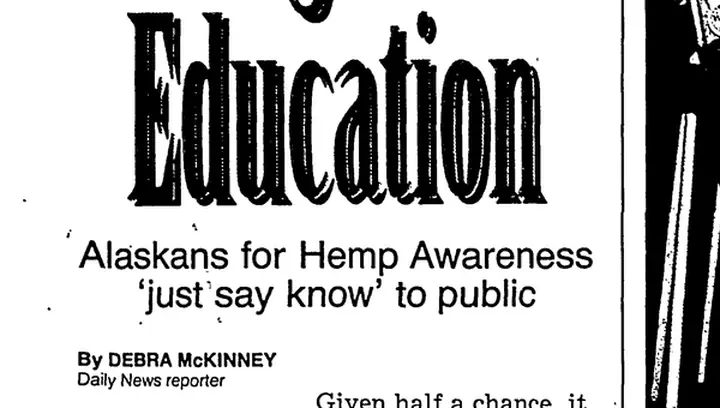
Alaskans for Hemp Awareness formed in 1990, after that vote, as an Anchorage hemp-education group (Anchorage Daily News, June 3, 1991). About 30 men and women set out to teach the public about hemp for paper, fiber, fuel, food and medicine. The slogan was “Just say know,” because, Tom Walls said, people heard “marijuana” and their minds slammed shut (Anchorage Daily News, Mar 28, 1991). Walls, one of the group’s founders, was an AHA board member. In the summer of 1990 he had a hemp booth at the Alaska State Fair. Most fairgoers walked past, and one called him “pond scum,” but he said he found enough interest to make it worthwhile (Anchorage Daily News, Mar 28, 1991).
A different group took the law to court. Two days after it took effect, Alaskans for Privacy sued, calling recriminalization a violation of the state constitution (Anchorage Daily News, Mar 28, 1991). Lawyer Bob Wagstaff, who had represented Irwin Ravin, argued that a voter initiative cannot overturn a state Supreme Court decision (Anchorage Daily News, June 3, 1991). The suit went to Superior Court Judge Karen Hunt (Anchorage Times, Mar 5, 1991). AHA backed it, and about 10 members picketed the state courthouse at noon Monday (Anchorage Times, Mar 5, 1991). Walls said the privacy people had snubbed the hemp people, but he still liked what they were doing (Anchorage Daily News, Mar 28, 1991).
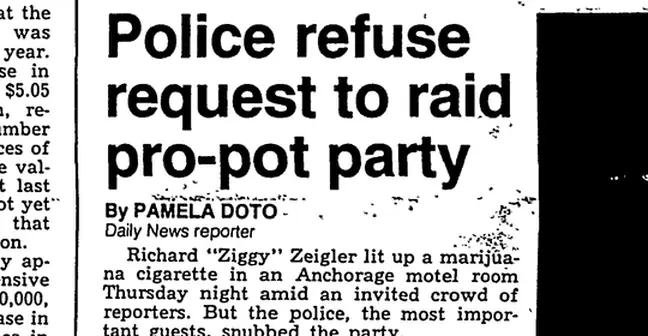
AHA’s own test was the “Idita-toke,” on the night of March 14, 1991. Named in honor of the Iditarod, it had been planned before the November vote (Anchorage Daily News, Mar 15, 1991). Members rented a $118 room at the Big Timber Motel, invited reporters, and smoked marijuana to test the new law (Anchorage Daily News, Mar 15, 1991; Anchorage Times, Mar 15, 1991). Police never showed up, and no arrests were made (Anchorage Daily News, Mar 15, 1991). Lt. Wade Lacey told the Daily News, “I made a determination that we wouldn’t respond at that time” (Anchorage Daily News, Mar 15, 1991). A member’s firsthand account of the call: the member phoned the police non-emergency line and asked, “Where are you guys?” The dispatcher said the police chief had ordered officers not to respond unless there was violence or a complaint from motel management. Neither happened.
In March 1995 the Daily News calendar listed a Hemp Fest at the University of Alaska Anchorage. The entry called it a “hemp awareness fest,” for all ages, with reggae, an open-mike jam and the local band Freedom 49, from 6:30 to 10:30 p.m. on March 11 at the UAA Campus Center Pub. Admission was $3, or $2 for UAA students (Anchorage Daily News, Mar 10, 1995).
2014–2015: Legalization
- Voters pass Ballot Measure 2, “An Act to Tax and Regulate the Production, Sale and Use of Marijuana,” 149,021 to 130,924 (53.23%) (2014 general election official results).
- The Anchorage Assembly votes 9–2 against a proposal to ban commercial cannabis in the city (Anchorage Daily News).
- The law takes effect. Adults 21 and older can possess up to 1 ounce and grow up to six plants, no more than three of them mature (Anchorage Daily News). Alaska becomes the third state with legal adult-use cannabis, after Colorado and Washington (NPR). Using it in public is a violation with a fine of up to $100, and Anchorage’s ordinance sets that fine at $100 (Anchorage Ordinance 2015-7, quoting AS 17.38.040).
- Gov. Bill Walker signs HB 123, Chapter 4, SLA 2015, creating the Marijuana Control Board. The act takes effect the next day (House Journal, May 12, 2015; Anchorage Daily News, May 6).
- Walker names the first members of the Marijuana Control Board (Anchorage Daily News; legislative appointment roster).
Media coverage of legalization day
The Associated Press story on legalization day ran in newspapers, TV station websites and national outlets across the U.S., with headlines that differed from outlet to outlet:
| Outlet | Headline | Date |
|---|---|---|
| The Detroit News (AP) | Details still hazy as pot becomes legal in AlaskaEarly version of the AP story; archived copy | Feb. 23, 2015 |
| Fox News (AP) | Alaska becomes third state to legalize recreational marijuana as ballot measure takes effect | Feb. 24, 2015 |
| Fox Business (AP) | Marijuana becomes legal in Alaska, but backers hope for low-key celebrations | Feb. 24, 2015 |
| CBS News (AP) | Alaska becomes third state with legal recreational marijuanaArchived copy | Feb. 24, 2015 |
| Talking Points Memo (AP) | Alaska Becomes Third State With Legal Marijuana But Bans Smoking In Public | Feb. 24, 2015 |
| Inc. (AP) | Alaskans Now Free to Enjoy Marijuana: So Now What?Archived copy | Feb. 24, 2015 |
| The Vindicator, Youngstown, Ohio (AP) | Alaska legalizes marijuana | Feb. 24, 2015 |
Other legalization-day coverage
Other outlets covering February 24, 2015 included:
- Anchorage Daily News: In Girdwood, marking a historic moment with plenty of now-legal pot (Feb. 25, 2015)
- Alaska Dispatch News, opinion by the Measure 2 campaign: Marijuana is legal Tuesday. If you’re celebrating, do so responsibly (Feb. 20, 2015)
- NPR: Marijuana Is Now Legal In Alaska, The 3rd U.S. State With Legal Pot (Feb. 24, 2015)
- NBC News: Northern Lights: Alaska on Tuesday Will Become Third State With Legal Marijuana (Feb. 2015)
- PBS NewsHour: It’s now legal to take a toke in Alaska (Feb. 24, 2015)
- The Christian Science Monitor: Alaska legalizes marijuana: Why no celebrations in the streets (Feb. 24, 2015)
2016–2019: Licenses, the first stores and onsite consumption
- The state’s first commercial cannabis regulations take effect (Alcohol and Marijuana Control Office).
- The Marijuana Control Board approves its first businesses, including CannTest, a testing lab in Anchorage, and Rosie Creek Farm, a cultivator near Fairbanks (Anchorage Daily News).
- The board approves Frozen Budz in Fairbanks as the first retail store, along with other retail applicants including Remedy Shoppe in Skagway (Anchorage Daily News). The Alcohol and Marijuana Control Office says the first retail license was issued on October 4, to Remedy Shoppe (AMCO history).
- Mat-Su Borough voters reject a ban on commercial cannabis outside Palmer, Wasilla, and Houston, and approve a 5% sales tax on retail cannabis (Anchorage Daily News, unofficial results).
- Pakalolo Supply Co. in Fairbanks makes Alaska’s first legal commercial sale. The owner called it ceremonial and said the store was not open to the public (Anchorage Daily News).
- Herbal Outfitters in Valdez opens at noon as the first cannabis store in Alaska open to the public, 725 days after the November 4, 2014 vote (Anchorage Daily News; Associated Press).
- Arctic Herbery opens as Anchorage’s first cannabis store (Anchorage Daily News).
- Voters turn down bans on cannabis businesses. With most ballots counted, unofficial results were about 70% against in the Fairbanks North Star Borough, 69% against in the City of Fairbanks, and 64% against in the Kenai Peninsula Borough (Anchorage Daily News).
- The Marijuana Control Board revokes Frozen Budz’s manufacturing license, the board’s first license revocation. The retail license was not the one revoked (Alaska Public Media).
- The state collects $10,801,357 in cannabis excise taxes (Department of Revenue, marijuana tax annual report).
- The Marijuana Control Board votes 3–2 to adopt rules for onsite consumption at licensed stores (Anchorage Daily News). The lieutenant governor’s filing sets the effective date at April 11, 2019 (regulation certificate).
- A spokesman says Gov. Mike Dunleavy will not introduce legislation that session to eliminate the Marijuana Control Board and the alcohol board. The commerce commissioner had listed that repeal among bills the governor was expected to offer (Anchorage Daily News).
- The Marijuana Control Board votes 3–2 to fire Erika McConnell, director of the state Alcohol and Marijuana Control Office (Associated Press).
2020–2026: Consumption lounges, cleared records and tax fights
- The board votes 3–2 to approve the first onsite consumption endorsements, for Cannabis Corner outside Ketchikan and GoodSinse in Fairbanks (Anchorage Daily News).
- Amended onsite-consumption rules take effect. The lieutenant governor had signed them on July 8 (Alaska Online Public Notices).
- Following a January 31 Alaska Supreme Court order, about 750 convictions for possessing an ounce or less, by someone who was 21 or older, are removed from the court system’s public CourtView website (KTOO / Alaska Beacon).
- Amended industrial-hemp rules take effect. They stop the state from endorsing a hemp product that contains delta-9-THC (Alaska Public Media). A federal magistrate judge grants summary judgment for the state on May 23, 2025 (judgment, Alaska Industrial Hemp Ass’n v. Alaska Department of Natural Resources).
- The House passes HB 119, a cannabis tax overhaul, 36–3, with one absent. It dies in the Senate (Legislature bill history).
- HB 91, the next tax reform bill, is in the House Rules Committee, where the Legislature’s bill history still places it. The $50-an-ounce tax on marijuana bud and flower remains (HB 91; Department of Revenue).
- HB 239 becomes law without Gov. Dunleavy’s signature, Chapter 9, SLA 2026 (Legislature bill history). Starting in 2027, a person convicted of possessing less than an ounce can ask the Department of Public Safety to keep that record off a background check (Alaska Public Media).
For the current rules, see Alaska cannabis laws & regional rules.
Sources
- Ravin v. State, 537 P.2d 494 (Alaska 1975) (May 27, 1975, as amended May 28, 1975)
- Constitution of the State of Alaska: art. I, § 22 (privacy), art. XI, § 1 (initiative), art. XIII (amendments). The privacy amendment’s August 22, 1972 ratification is in a Legislative Research Services report.
- Noy v. State, 83 P.3d 538 (Alaska App. Aug. 29, 2003) · rehearing, 83 P.3d 545 (Nov. 14, 2003) · State v. ACLU of Alaska, 204 P.3d 364 (Alaska 2009)
- Jason Brandeis, “The Continuing Vitality of Ravin v. State,” Alaska Law Review (2012) (May 16, 1975 legislative journals)
- Division of Elections: initiative history (1990, 2000, 2004, and 2014 vote totals), 1998 official results, 2014 official results
- Alaska Legislature: HB 149 (2006) · ACLU on the 2006 Collins ruling
- Anchorage Daily News: Anchorage Assembly vote, Marijuana Control Board law, first retail approvals, first sale, Anchorage’s first store, 2017 local votes, first consumption shops
- Alaska Public Media: Alaska’s first pot shop opens Saturday (published Oct. 26, 2016). Its headline counts 722 days, the span from the vote to that story. The Valdez opening on Oct. 29 is 725 days after Nov. 4, 2014.
- NORML: Onsite consumption rules finalized (2019)
- KTOO: Marijuana convictions removed from CourtView (2023)
- Alaska Public Media: Record sealing under the new law (2026)
Citations on the timeline were checked against court opinions, Division of Elections results, legislative bill histories, and news reports on October 24, 2026. The Hemp Awareness section, added October 21, 2026, still cites Anchorage Daily News and Anchorage Times editions by date. Those local stories do not have a free public link here, except where a New York Times story covers the same week. The March 14, 1991 dispatcher exchange is a member’s firsthand account, not a newspaper report. The Alcohol and Marijuana Control Office history page misstates the 2014 yes share, so the vote totals above use the Division of Elections instead. If you spot an error, let us know.